Prison warden's uniform
Three SecondsThe Prison warden's uniform is central to Piet Hoffmann’s escape from Aspsås Prison: clothing that once belonged to principal officer Martin Jacobson becomes a disguise that allows Hoffmann to move through the prison as though he belongs there. Its importance is practical rather than ceremonial. In a place governed by locked doors, staff routines, and recognition, the uniform supplies an identity that can pass where the prisoner himself could not.
Provenance and preparation
The uniform belonged to Martin Jacobson, a principal prison officer. By the time Hoffmann retrieves it, the clothes have already served another purpose: he had used them as a makeshift pillow. He takes the garments from their hiding place and finds that their owner’s approximate height makes them a workable fit. The trousers are somewhat short and the shoes tight, but the differences do not show enough to defeat the disguise. The clothes also carry signs of another wearer, including the smell of deodorant or aftershave, a small but telling mark of the identity Hoffmann is about to assume.
The change of clothes is part of a broader alteration of appearance. Hoffmann cuts his hair to a few millimetres and shaves away the beard he had begun growing. Four days earlier he had long, fair hair and a three-week beard; now he is cropped and clean-shaven. The uniform therefore does not work alone. It is paired with a face and silhouette changed to match the role, while Hoffmann’s practiced control of his own reactions helps him sustain the appearance under pressure.
A disguise made for the prison
The uniform matters because Aspsås Prison is not simply a building to cross. Hoffmann has learned its spaces and routines, but movement inside it remains regulated: security doors divide passages, staff control access, and prisoners are expected to remain in their assigned places. He has already experienced the force of that system, from the restraints and guarded intake on arrival to the strict confinement of his cell. The uniform gives him a way to navigate those boundaries as staff rather than as an inmate.
Hoffmann’s knowledge of prison life has been accumulated before and during his imprisonment. Before entering Aspsås, he mapped its buildings from the church tower and studied the windows; while on remand, he learned about the prisoners and staff in Block G. Once inside, he observed how officers conducted routines and how prisoners established status among themselves. The uniform converts that knowledge into mobility. It is useful not because it makes him invisible in every sense, but because it makes his presence legible as something the institution expects to see.
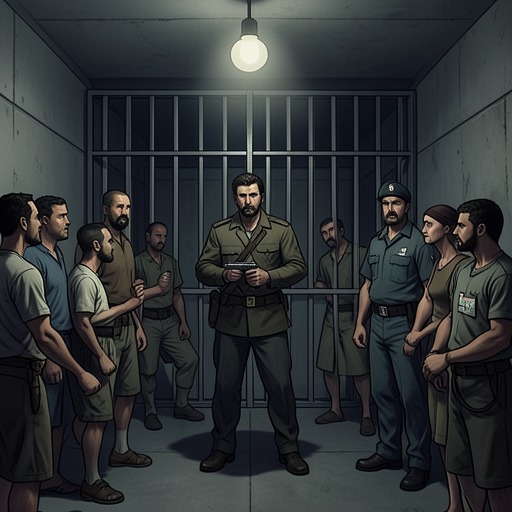
That distinction is especially important at the prison’s internal thresholds. After the hostage crisis and explosion, Hoffmann waits until he believes the staff passing nearby are members of the night shift who do not know the prisoners by sight. He opens the door, enters the passage, and approaches three wardens near a locked security door between Block G and central security. The uniform is the visible credential that supports this encounter; timing and an ordinary request to wait for him complete the performance. His escape depends on the convergence of clothing, familiarity with the layout, and a moment when recognition is uncertain.
From hidden clothing to escape
During the explosion’s aftermath, Hoffmann takes the uniform clothes and throws them through a window before jumping onto a roof below. The smoke obscures the workshop area, and his hearing is badly impaired, leaving him to judge movement around him by what he can perceive. A police officer even runs into him without recognizing who he is. Hoffmann then waits to avoid guards who have seen his face, distinguishing them from the later shift whose members have not met the prisoners.
When the opportunity comes, he joins the night-shift wardens and passes through the security passage. The seasonal staffing pattern assists him: at the end of May, Aspsås brings in summer employees, some with only a short introduction and brief course before starting work. The text does not make the uniform a perfect disguise or suggest that every officer is deceived. Instead, the escape turns on a narrower opening: these particular employees do not know the prisoners’ faces, and Hoffmann appears to belong among them. He reaches the gate and leaves the prison without anyone shouting or moving to stop him.
Significance
The uniform condenses the novel’s concern with criminal and official identities into a concrete object. Hoffmann has survived by performing roles, and here the performance is reduced to its material essentials: borrowed clothes, an altered appearance, knowledge of procedure, and the confidence to act as though he has authorization. The garments do not erase the prison’s controls; they let him exploit the gap between formal security and the human act of recognizing who is entitled to pass.
Its history also sharpens the reversal. Jacobson’s clothes had been reduced to an improvised pillow before becoming the means by which Hoffmann takes on the appearance of a guard. Their ordinary use is repeatedly displaced by the demands of confinement and escape. At the gate, the uniform has done what Hoffmann needs of it: it presents him not as the prisoner the institution is searching for, but as a staff member whose presence attracts no alarm. The clothes are left behind as part of an escape built on turning the prison’s own signs of authority against its walls.